
Advanced Cash Management: Beyond the Dashboard
You've built your dashboard. You're tracking days of cash on hand, monitoring your grant pipeline, and watching for early warning signs. You're no longer flying blind, and that's a significant accomplishment.
But most dashboards only show you trends in what's already happened. What if you want to see around corners - to anticipate problems? What if you're facing a specific cash challenge and need tools to manage through it?
This is where you move from monitoring to active cash management. These tools require more effort to build and maintain, but for organizations facing cash volatility, growth, or complex funding structures, the investment pays off in reduced anxiety and better decisions.
Cash Flow Projections: Seeing What's Coming
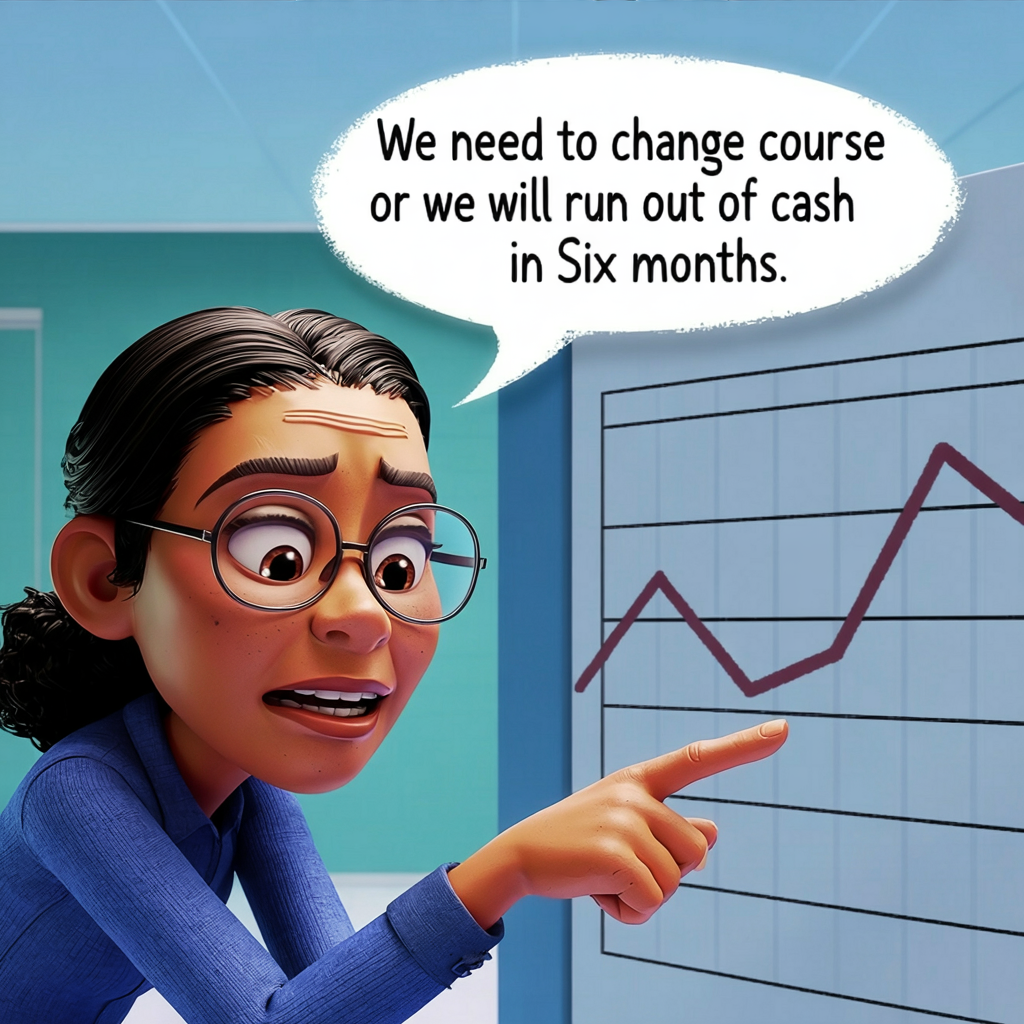
A cash flow projection is fundamentally different from a budget. Your budget shows what you plan to earn and spend over the year. A cash flow projection shows when specific dollars will move in and out of your bank account, typically looking 3-6 months ahead.
This distinction matters enormously. You might have a perfectly balanced budget with a $200K grant awarded and included in revenue. But if that grant pays quarterly in arrears and you have $80K in expenses due in month two while the first payment doesn't arrive until month four, your budget looks fine while your checking account is empty.
Who Needs Cash Flow Projections?
Not every organization needs a cash flow projection. If you have steady, predictable revenue and expenses throughout the year, your dashboard's days of cash on hand metric might be sufficient.
Cash flow projections become essential for organizations with:
Lumpy revenue where large grants arrive quarterly or annually rather than monthly
Reimbursement-based funding where you spend money first and get repaid 30-90 days later (or sometimes even longer these days with government grants)
Seasonal programs that have intense periods of activity and expense (summer camps, holiday services, back-to-school programs)
Growth plans requiring upfront investment before new revenue materializes
Multiple restricted grants, each with different payment schedules and reporting requirements
If you've ever had a month where you knew money was coming but weren't sure you'd make it to payday, you need projections.
Building Your Projection (Step by Step)
Start with a spreadsheet with months across the top as column headers. Your second row is your starting cash balance - what's actually in your bank account at the beginning of the month. Your last row will be the ending cash balance. All the rows in between will be your revenue and expenses.
Under "Cash In" (revenue), list expected payments in the specific month you realistically expect it to arrive. Not when the grant period starts or when you submit an invoice, but when the actual payment will hit your account. Include:
Grant payments (initial, reimbursements, final payments)
Government contracts
Individual donations (if substantial and predictable)
Earned revenue from programs
Special events (net proceeds)
Any other revenue sources
For major revenue sources, like a gala or your top funders, consider giving those a row of their own.
Be conservative with timing. If a funder typically processes reimbursements in 30 days, assume 45 days in your projection. If a foundation says they'll pay "within 60 days of signing," assume 75 days. You're not trying to be pessimistic; you're building a tool you can rely on.
Under "Cash Out" (expenses), list your regular monthly expenses:
Payroll (including taxes and benefits)
Rent and utilities
Insurance
Contracted services
Program supplies and expenses
Professional fees
Then add major expenses that hit quarterly or annually such as liability insurance renewals, software licenses, equipment purchases, audit fees. These irregular expenses are easy to overlook when you're thinking month-by-month, and they're often what creates surprise cash crunches.
For each month, calculate: Starting Cash + Cash In - Cash Out = Ending Cash. That ending cash becomes the starting cash for the next month.
What Your Projection Tells You
Look at your ending cash balance for each month. Are you ever negative? That's a problem you can see coming.
Are you cutting it close? Maybe ending a month with only $15K when your monthly payroll is $40K? That's risky even if you're technically positive.
The projection also reveals your cash flow pattern. Maybe you're consistently tight in months three and four, then comfortable in months five and six when large grant payments arrive. Understanding this pattern helps you plan interventions strategically.
Maintaining Your Projection
Here's the challenge: projections become outdated quickly. Grant payments get delayed. Expenses shift. New grants get awarded. If you build a projection in January and never update it, you're working with fiction by March.
Plan to update your projection at least monthly, ideally every two weeks. Review what actually happened versus what you projected. Adjust future months based on new information. Move payments that didn't arrive to the next month. Add newly awarded grants. Update expense timing.
This sounds burdensome, but once you have the template, updates can take as little as 30-60 minutes. And the value is immense: you're maintaining situational awareness about your organization's cash position that most nonprofit leaders lack.
Taking Action on What You See
The power of projections is they give you time to act before a cash shortfall arrives. If your projection shows you'll be $50K short in month four, you have options now that won't exist when month four is here:
Accelerate revenue: Can you submit grant reports early to trigger reimbursements sooner? Can you invoice for services delivered faster? Can you have conversations with funders about modified payment schedules or advance payments?
Defer expenses: Are there discretionary purchases you can postpone? Can you negotiate extended payment terms with vendors? Can you spread a large purchase across multiple months?
Bridge the gap: Do you have a line of credit you can draw on strategically for 60-90 days? Can you arrange a short-term loan from a board member or affiliated organization?

Small cuts: Sometimes you may also have to consider layoffs. Laying off one person in January can be easier and less disruptive than laying off six people in June when the cash emergency is at your doorstep.
These options require lead time. Three months of runway gives you time to have professional conversations with funders or negotiate with vendors. Three days of runway means you're begging for emergency help.
Scenario Planning: Preparing for Uncertainty
Once you're comfortable with basic cash flow projections, you may want to add scenario planning: multiple versions of your projection based on different assumptions.
Your base case projection assumes everything goes according to plan: grants arrive when expected, expenses stay on budget, no surprises. But what if things go differently?
You can build a "pessimistic scenario" where you assume:
Grant payments arrive 30 days later than expected
One anticipated grant doesn't come through
Expenses run 10% higher than projected
Earned revenue comes in 15% below expectations
This isn't about saying “the sky is falling.” It's about stress-testing your cash position. If your pessimistic scenario shows you running out of cash in month three, that's important strategic information. You might decide to be more aggressive about building reserves, more cautious about new spending, or more proactive about securing a line of credit.
Some organizations also build an "optimistic scenario" - everything goes well, grants arrive early, expenses come in under budget. This helps you plan for what you could do with breathing room: hire that key position sooner, invest in infrastructure, or build reserves faster.
The discipline of scenario planning forces you to think through "what if" questions before they become real. What if the state budget impasse delays your largest contract payment by 90 days? What if the federal government shuts down or freezes grant reimbursement checks? What if your earned revenue program has slower enrollment than expected? You're not predicting the future; you're preparing for multiple possible futures.
Working Capital Strategies: Creating Your Own Breathing Room
All this monitoring and projecting is useful, but the ultimate solution to cash flow stress is having adequate working capital - enough cash reserves to absorb the normal ups and downs of nonprofit operations.
Most financial advisors recommend nonprofits maintain operating reserves equal to 3-6 months of expenses. For many organizations, this feels impossibly distant. You're trying to make payroll, not build a six-month cushion.
Start smaller. Can you build a reserve equal to two weeks of expenses this year? Then add two more weeks of expenses annually? Define a realistic target and work toward it incrementally. Even $20K of reserve funds changes your options when unexpected challenges arise.
Building reserves requires systematic effort:
Budget for a surplus (profit): Instead of budgeting to spend every penny that comes in, budget to spend less than you bring in next year. That surplus becomes your reserve fund. Then, when you end a year with a surplus, move it to a designated reserve account rather than letting it sit in operating funds where it will get inadvertently spent.
Capitalize one-time windfalls: Unexpected donations, bequests, favorable grant amendments, or program surpluses are opportunities to build reserves rather than expand operations.
Include reserve building in grant budgets if your funders will allow it: When you're developing budgets for new grants, include indirect cost recovery at the full allowable rate and designate a portion of that recovery for reserves.
Communicate the strategy to your board: Building reserves should be an explicit organizational priority with board support. This gives you cover when board members want to spend surplus funds on new initiatives rather than save them.
Managing Reimbursement-Based Funding
Many nonprofits operate on reimbursement-based contracts where you deliver services, incur expenses, submit documentation, and then wait 30-90 days for payment. This funding model creates inherent cash flow challenges because you're essentially providing a free loan to your funder.
Strategies for managing reimbursement cash flow:
Invoice immediately and frequently: Don't wait until month-end if you can invoice weekly or bi-weekly. The sooner you submit, the sooner the reimbursement clock starts.
Understand each funder's payment cycle: Some funders process payments weekly, others monthly. Some pay exactly 30 days from invoice receipt, others take 60 days. Track actual payment timing for each funder and build that reality into your projections.
Negotiate advance payments: Some government and foundation funders will provide advance payments if you ask, particularly for new contracts or when you can demonstrate cash flow challenges. This isn't a sign of organizational weakness; it's a legitimate request that sophisticated nonprofits make regularly.
Limit reimbursement-based funding as a portion of your budget: If 90% of your revenue is reimbursement-based, you're putting enormous strain on cash flow. Diversifying revenue sources to include some predictable monthly income (individual giving, membership fees, advance-paid grants) reduces cash volatility.
Consider lines of credit: A line of credit specifically sized to cover your typical reimbursement lag can be a cost-effective tool. If you regularly have $75K outstanding in reimbursements, a $100K line of credit bridges that gap. You only pay interest on what you use, and you draw and repay as reimbursements come in.
Pro tip on Lines of Credit: You’ll probably get a more generous line of credit if you apply for one when you have plenty of cash in the bank. If you wait until cash has almost run out, you’ll likely receive a smaller line of credit and any paperwork delay could mean the cash arrives too late.
When Funders Pay Late: Having the Conversation
Funder payment delays are a reality in nonprofit finance, particularly with government contracts. Your projection shows a payment should have arrived, but it hasn't. Now what?
First, check your end of the process. Has the required report been submitted? Are there any outstanding questions or documentation requests? Have you followed up to confirm receipt?

If everything is submitted correctly and the payment is genuinely late, you need to have a professional conversation with your program officer or contracts manager. This conversation is easier when you've been tracking and can be specific: "Our contract agreement indicates payment within 30 days of report submission. We submitted the Q2 report forty-five days ago, and we haven't yet received payment. Can you help me understand the timeline?"
Most delays are bureaucratic rather than intentional - approvals sitting on someone's desk, processing backlogs, technical issues. A polite inquiry often accelerates things (don’t channel Rihanna for this one).
For chronic late payers, adjust your expectations and planning. If a funder's contract says 30 days but they consistently pay in 60 days, plan for 60 days. Yes, they should honor their agreement, but your cash flow can't afford to be repeatedly surprised by their pattern.
Knowing When You Need Help
These tools - projections, scenario planning, working capital strategies - can help you manage cash flow challenges. But they have limits. If your projections consistently show you running out of cash despite your best management efforts, that's not a projection problem. That's a fundamental business model problem.
Warning signs you need outside help:
Projections show persistent cash shortfalls even with optimistic assumptions
You're regularly paying bills late or delaying payroll
You're using restricted funds to cover unrestricted expenses (even "temporarily")
You're taking on debt with no clear plan to repay it
Management is spending more time managing cash crises than leading the organization
These situations call for strategic financial restructuring, possibly with help from a consultant, financial advisor, or turnaround specialist. The tools in this article help you manage cash flow volatility in an otherwise healthy organization. They can't fix structural deficits or unsustainable program models.
Conclusion
Moving beyond dashboards to active cash management represents significant maturation in financial leadership. You're not just monitoring what's happened; you're anticipating what's coming and taking action to shape outcomes.
These tools require more effort than the dashboard metrics in our previous article. Cash flow projections need regular updating outside your accounting system. Scenario planning takes time to build and think through. Working capital strategies require discipline over months and years.
But for organizations facing cash volatility this pays off in reduced financial stress, better decision-making, and the confidence that comes from knowing you won't be surprised by preventable cash crises.
Start with projections. Build three months out, update monthly, and learn what your organization's cash flow pattern looks like. That one tool, maintained consistently, will change how you lead.
Your mission deserves financial leadership that can see what’s over the horizon rather than just reacting. These tools help you get there.